⚡ Quick Answer
The Sun Home Equinox 2 ($6,099) is the best infrared sauna for most buyers in 2026 — 2-person full-spectrum with near, mid, and far infrared, third-party ultra-low EMF certified (under 0.5 mG), eucalyptus construction, and runs on a standard 120V/20A circuit. For premium outdoor use, the Sun Home Luminar ($10,999) is built with an aerospace-grade aluminum exterior that needs no annual staining. Budget pick: the Dynamic Barcelona ($3,499) is the best entry-level cabin for buyers who want a real infrared sauna without spending five figures. Prices verified August 6, 2026.

How We Researched This Guide
Disclosure: PlungeHQ has not physically tested all products on this page. This guide is an editorially researched comparison based on manufacturer specifications, warranty documentation, published third-party EMF test data, and competitive analysis — all verified against official product pages as of August 6, 2026. Products marked "specification-researched" were not physically tested by PlungeHQ. Our recommendations are never influenced by affiliate commission rates.
Verification sources: Equinox 2 product page | Sun Home warranty information | Luminar product page | Dynamic Saunas | JNH Lifestyles | Radiant Health | Sunlighten
What Makes an Infrared Sauna Good? The Buying Criteria
Most infrared sauna buyers focus on price and looks. The buyers who end up disappointed focused on the wrong things. Here's what actually separates a good infrared sauna from a mediocre one:
1. Heater Type: Carbon vs. Ceramic
This is the single most important technical spec, and it's almost never explained properly on product pages.
- Carbon heaters have a large surface area and operate at lower surface temperatures (~140–150°F). The result: even, whole-body radiant heat that wraps around you rather than blasting from one point. Most people find longer sessions more comfortable with carbon. This is what premium brands use.
- Ceramic heaters run hotter at the surface (~150–180°F+) and produce more intense, concentrated heat. Cheaper to manufacture. The heat is real, but coverage is spottier. Common in budget models.
- Carbon/ceramic combo: Some mid-range brands combine both — ceramic for intensity, carbon panels for coverage. A reasonable compromise.
- Full-spectrum heaters add near and mid infrared wavelengths on top of far infrared. Near infrared penetrates skin more shallowly and is associated with skin and cellular benefits; mid infrared sits between the two. Full spectrum is a premium feature that adds meaningful cost.
Bottom line: For a home sauna you'll use 3–5x per week for 20–30 minute sessions, carbon heaters are noticeably more comfortable over time. Note: Sun Home Equinox 2 uses eucalyptus, not hemlock — always verify the wood species on the manufacturer's current product page before purchasing. Don't pay a premium for "ceramic" as if it's better — it's a budget indicator.
2. EMF Levels: What "Low EMF" Actually Means
EMF (electromagnetic field) exposure from infrared heater elements is a genuine concern worth investigating — but the marketing language is almost completely unregulated, which makes it confusing.
- Ultra-low EMF (best): Third-party tested below 1–3 milligauss (mG) at body distance (1–2 inches from the panel). Brands like Clearlight and Sun Home publish actual test results from independent labs. This is what you want.
- "Low EMF" claims without data: Meaningless. Any brand can write "low EMF" on their product page without testing. Ask the manufacturer for third-party documentation before purchasing.
- What to do: If EMF is a priority, buy only from brands that publish specific milligauss readings from a named third-party lab. Clearlight and Sun Home both do this transparently. If a brand can't answer this question directly, move on.
3. Wood Quality
The wood in an infrared sauna is structural — it gets hot, it holds moisture, and it expands and contracts with temperature cycling thousands of times over its lifespan. Budget wood fails faster and can warp, crack, or off-gas.
- Canadian hemlock: The most common wood in mid-to-premium home saunas. Light color, tight grain, low resin content (won't off-gas at heat), naturally resistant to warping. Good choice at any price point.
- Cedar (Western Red Cedar): Aromatic, naturally antimicrobial, and classic sauna wood. More expensive. The strong cedar smell is pleasant for many users but can be overpowering for some — a real preference issue, not a quality issue.
- Basswood: Very light, hypoallergenic, and odorless — preferred by people sensitive to cedar's oils. Not quite as durable as hemlock long-term, but perfectly adequate for home use.
- What to avoid: Unspecified "pine" or no wood type listed at all. Pine has high resin content, can off-gas at sauna temperatures, and warps more easily than hemlock or cedar.
4. Heater Placement
A sauna with heaters only on the back wall is not a full-body infrared sauna, regardless of what the marketing says. Quality infrared coverage requires heaters positioned to reach your front, back, sides, and ideally your legs and feet.
- Full coverage: Back wall, side panels, and floor panels (for calves/feet). Some premium models add a low-level panel below the bench for leg coverage.
- Back-only models: Common in budget saunas. You'll get a real sweat and real benefits — but one side of your body gets significantly more heat than the other. Fine for budget use, but not what a premium price should deliver.
- Full-spectrum saunas require heaters positioned at multiple levels (low, mid, high on the walls, and floor) for the infrared wavelengths to cover the whole body. If a "full-spectrum" sauna only has back panels, it's not using the full spectrum effectively.
5. Control Panel & Features
- Digital control panels are standard above $800 — look for external controls so you can adjust temperature without opening the door.
- Pre-set programs: Some brands offer preset programs (relaxation, detox, pain relief) that cycle heater zones and temperatures. Mostly a convenience feature, not a must-have.
- App control: Available on newer premium models (Sunlighten mPulse, some Clearlight models). Lets you preheat from your phone before you arrive home.
- Chromotherapy (color light therapy): Standard on mid-range and up. The research on chromotherapy is thin, but it adds ambiance at minimal extra cost.
- Bluetooth audio: Available on most saunas above $1,200. Worth having if you do long sessions — 30 minutes of music or podcasts is significantly more enjoyable than silence.
6. Warranty — What Good Looks Like
Infrared saunas have components that fail at different rates. A quality warranty covers each component appropriately:
- Heaters: 10+ years (good) — this is the most critical component. 3–5 year heater warranties are a red flag on a $2,000+ sauna.
- Wood structure: 5+ years (good). Wood issues (warping, cracking) typically emerge in the first 2–3 years if they're going to happen at all.
- Electrical components/control panels: 3+ years (good).
- Labor: At least 1 year covered. Some premium brands offer lifetime warranty on the entire unit.
Always read the warranty terms carefully — some brands offer "lifetime" warranties on individual components while giving only 1 year on others. The heater warranty is the number that matters most.
How We Scored Each Sauna
Every infrared sauna in this guide was evaluated against the same six criteria, weighted by what matters most in daily ownership. The "best overall" pick is the sauna that scores highest across all weighted criteria — not the one with the highest price or loudest marketing.
| Ranking Factor | Weight | What We Evaluated |
|---|---|---|
| Heat performance & distribution | 25% | Heater type (carbon vs ceramic), full-spectrum vs far-IR only, heater count and placement, maximum temperature, heat-up time |
| Verified safety documentation | 20% | Third-party EMF test results with specific milligauss readings, VOC certifications, electrical safety compliance, fire-rated materials |
| Construction & durability | 15% | Wood species and grade, joinery method, hardware quality, expected lifespan under normal use |
| Comfort & usable interior space | 15% | Bench dimensions, ceiling height, shoulder/hip clearance, realistic body fit, reclining comfort |
| Warranty & service | 10% | Heater warranty duration, cabinetry warranty, control/electronics coverage, labor coverage, service network |
| Installation & electrical | 5% | Circuit requirements (120V vs 240V), assembly complexity, number of people needed, tool requirements |
| Controls & features | 5% | Control panel type, app connectivity, chromotherapy, Bluetooth audio, preset programs |
| Price-adjusted value | 5% | Performance and warranty per dollar spent |
Important: This is an editorial weighting model based on manufacturer specifications and warranty documentation verified against official product pages as of August 6, 2026. PlungeHQ has not physically tested all products on this page. Scores are editorial assessments, not laboratory measurements.
Best Infrared Saunas 2026: Quick Comparison
| Model | Price | Capacity | Heater Type | EMF Rating | Wood | Heater Warranty | Verdict |
|---|---|---|---|---|---|---|---|
| Sun Home Equinox 2 | $6,099 | 2 | Full spectrum | Ultra-low (3rd-party certified, 0.5 mG) | Eucalyptus | 7yr cabinetry & heaters | Best overall |
| Sun Home Luminar | $10,999 | 2–5 | Full spectrum | Ultra-low (3rd-party certified) | Canadian red cedar | Lifetime | Best outdoor |
| Dynamic Barcelona | $3,499 | 1–2 | Carbon far IR | Low (not 3rd-party published) | Canadian hemlock | 5 years | Best budget cabin |
| JNH Lifestyles Ensi | $2,099 | 1–2 | Carbon far IR | Low EMF published | Canadian hemlock | 3 years | Best mid-range value |
| Radiant Health Pause | $5,840 | 1 | Carbon far IR | Ultra-low (3rd-party certified, 0.65 mG) | Canadian hemlock | Lifetime | Best ultra-low EMF |
| Sunlighten Solo | $2,099 | 1 | Full spectrum | Ultra-low (3rd-party certified) | Basswood | Lifetime | Best portable full-spectrum |
Best Overall: Sun Home Equinox 2
Sun Home Equinox 2 2-Person Full-Spectrum Infrared Sauna
- Near-zero EMF/ELF — independently tested and published (under 0.5 mG at body distance)
- Full spectrum: 4 far infrared + 2 full-spectrum heaters (near, mid, and far IR)
- 2-person capacity with 45.2" × 20.2" bench
- Eco-certified kiln-dried eucalyptus construction — durable, low-VOC, non-toxic
- Digital onboard control panel with 24-hour programmable timer and reservation mode
- Built-in Bluetooth surround sound (Blaupunkt speakers) + medical-grade chromotherapy LEDs
- Magne-Seal assembly system — no power tools, screws, or nails required
- Warranty: 7 years cabinetry & heaters, 3 years controls, 1 year glass & audio
- 120V dedicated 20-amp circuit required (NEMA 5-20p plug) — does NOT use 240V
Disclosure: Specification-researched — not physically tested by PlungeHQ. Specs verified against manufacturer product page and warranty documentation, August 6, 2026.
The Sun Home Equinox 2 is our top pick for 2026 because it delivers full-spectrum infrared in a well-built 2-person cabin with independently verified low EMF and transparent warranty terms. The 4 far infrared heaters plus 2 full-spectrum panels provide near, mid, and far infrared coverage — more complete wavelength coverage than far-IR-only saunas at this price point.
Construction is eco-certified kiln-dried eucalyptus, chosen for durability and heat response. This is not hemlock or cedar — it's eucalyptus, which is what the manufacturer actually uses. The electrical requirement is a dedicated 120V/20A circuit (NEMA 5-20p plug) — this is important because many 2-person saunas require 240V. The Equinox 2 does not. Controls are via a digital onboard panel with programmable timer and reservation mode — there is no native app, remote preheat, or guided breathwork feature.
The warranty is component-specific: 7 years on cabinetry and heaters, 3 years on controls, and 1 year on glass doors and audio. This is not a "lifetime warranty" on everything — it's a transparent component schedule. At $6,099 (on sale from $6,799 at time of verification), it's a premium purchase backed by documented third-party EMF testing, which most competitors at this price don't publish.
Best for: Buyers who want full-spectrum infrared (near, mid, and far) in a 2-person cabin with independently verified ultra-low EMF. The 120V/20A circuit requirement makes this the best full-spectrum sauna for homes without 240V service. Also the best choice for buyers who value transparent warranty documentation and third-party safety testing.
Not ideal for: Buyers who want app-based smartphone control or integrated red light therapy. For app control and red light, consider the Sun Home Eclipse series instead. Anyone who wants a sauna large enough to fully recline — the 45.2" × 20.2" bench is comfortable for seated use but may not accommodate a full recline unless you're under ~5'8".
Why it won: The combination of full-spectrum heating, third-party EMF testing (under 0.5 mG), and transparent component-level warranty documentation is not matched by any competitor at $6,099. Most saunas at this price offer far-infrared only or make EMF claims without publishing lab results.
Closest alternative: The Radiant Health Pause ($5,840) offers similarly rigorous EMF documentation (0.65 mG, zero VOC certified) in a 1-person format at a slightly lower price — a strong choice if you don't need 2-person capacity.
Pros
- Full-spectrum (near + mid + far IR) in a 2-person cabin
- Third-party EMF tested under 0.5 mG
- Eucalyptus construction — durable and low-VOC
- 120V/20A — no 240V circuit needed
- Transparent component-specific warranty
Cons
- No smartphone app control
- No integrated red light therapy
- Bench is 45.2" × 20.2" — reclining may not be comfortable for all users
- Warranty is component-specific (not full lifetime)
Best Outdoor: Sun Home Luminar
Sun Home Luminar 2-Person Outdoor Infrared Sauna
- Patented aerospace-grade aluminum exterior — zero annual maintenance
- Marine-grade matte black hardware — built for rain, snow, and sun
- Canadian red cedar interior with full-spectrum heaters
- Optional built-in red light therapy add-on
- No annual staining, no cover required between sessions
- Available in 2-person and 5-person sizes
The Sun Home Luminar solves the biggest headache of outdoor sauna ownership: maintenance. Traditional outdoor saunas require annual staining, periodic resealing, and covers to protect against weather. The Luminar's aerospace-grade aluminum exterior eliminates all of that — it's designed to sit outside year-round with zero cosmetic maintenance. The marine-grade hardware won't rust, and the Canadian red cedar interior delivers the authentic sauna experience.
At $10,999 (on sale from $11,599), it's a significant investment — but you're getting the only outdoor infrared sauna with a lifetime warranty and zero-maintenance exterior. Available in 2-person and 5-person configurations, with an optional red light therapy add-on. If you want an infrared sauna on your deck or patio and never want to think about staining or covering it, this is the only option that delivers.
Best for: Anyone installing a sauna outdoors — deck, patio, poolside, or garden. The aerospace-grade aluminum exterior and marine-grade hardware are uniquely engineered for weather exposure. Also the best choice for buyers who want a sauna with a lifetime warranty across all components (not component-specific). Available in a 5-person configuration for families or shared use.
Not ideal for: Indoor-only buyers — the weatherproof exterior adds cost you don't need if the sauna will live in a basement or spare bedroom. Budget-conscious buyers — at $10,999, it's the most expensive sauna in this guide. Buyers in HOAs or with deed restrictions should verify outdoor structure rules before purchasing.
Why it won: It's the only outdoor-rated infrared sauna with zero annual maintenance. Every other sauna marketed for outdoor use requires staining, sealing, and covering. The Luminar eliminates that entire maintenance category.
Closest alternative: A traditional outdoor barrel sauna at $4,000–$7,000 — significantly cheaper and weather-resistant, but uses traditional Finnish heating rather than infrared and requires annual staining.
Best Budget Cabin Sauna: Dynamic Barcelona
Dynamic Barcelona 1–2 Person Infrared Sauna
- 6 carbon PureTech low-EMF heating panels — excellent coverage for a 1–2 person cabin
- Canadian hemlock construction (not pine)
- Digital control panel + chromotherapy lighting
- Bluetooth audio + chromotherapy lighting included
- 5-year heater warranty — solid for this price tier
At $3,499, the Dynamic Barcelona is the best entry point into a real cabin sauna without moving into four-figure territory beyond the basics. The 6 carbon panels provide decent coverage for a 1–2 person cabin, hemlock wood holds up better than budget alternatives, and the 5-year warranty on the heaters gives confidence that the core component won't fail immediately. It's not going to match the build quality or feature set of a $6,000 full-spectrum unit — but it's a genuine infrared sauna that will deliver real benefits at the lowest price we'd actually recommend.
Best for: First-time sauna buyers on a budget who want a real wood cabin (not a tent or blanket). The 6 carbon panels and hemlock construction are genuine sauna materials at an entry-level price.
Not ideal for: Buyers who prioritize EMF documentation — Dynamic does not publish third-party EMF test results. Anyone wanting full-spectrum (near + mid + far infrared) — this is far-infrared only. Buyers over 6' tall may find the 1–2 person cabin tight.
Why it won: It's the lowest-priced cabin sauna in this guide that uses proper Canadian hemlock (not pine) and includes Bluetooth, chromotherapy, and a digital control panel — features normally reserved for the $4,000+ tier.
Closest alternative: The JNH Lifestyles Ensi ($2,099) is $1,400 less and actually includes published EMF data (0.32 mG), making it the better value pick if EMF transparency matters more than brand recognition.
Best Ultra-Low EMF Sauna: Radiant Health Pause
Radiant Health Pause 1-Person Infrared Sauna
- Third-party verified ultra-low EMF (0.65 mG average) at body contact
- Zero VOC certified — A+ rating for French VOC standards
- Individual heat control zones — bench top, calf, and floor
- Red light and near-infrared compatible (Shine 2 add-on)
- Mobile app for remote control and pre-heating
Radiant Health (formerly Radiant Saunas) has repositioned itself in the premium segment with the Pause model. At $5,840, it's priced above the mid-range tier, but it backs that up with genuinely impressive specs: third-party verified ultra-low EMF (0.65 mG), zero VOC certification, and individual heating zone controls. The lifetime warranty and optional red light therapy add-on make it competitive with premium brands. If EMF transparency and indoor air quality matter to you, this is the most thoroughly documented sauna in its class.
Best for: Buyers whose top priority is documented low EMF and indoor air quality. The 0.65 mG third-party reading and A+ French VOC rating are rare in any price tier. Also the best choice for buyers who want individual heating zone control (bench, calf, floor) rather than all-or-nothing heater operation.
Not ideal for: Anyone who needs 2-person capacity — this is a 1-person sauna. Buyers wanting full-spectrum — the Pause is far-infrared only (carbon panels). The heater warranty at 3 years is shorter than Equinox 2's 7 years.
Why it won: The combination of third-party EMF documentation and zero-VOC certification is unmatched at this price. This is the most thoroughly safety-documented sauna in the guide.
Closest alternative: The Sun Home Equinox 2 ($6,099) offers full-spectrum heating and a 2-person cabin for $259 more, with comparable EMF documentation — a better overall value unless you specifically need 1-person and VOC certification.
Best Mid-Range Value: JNH Lifestyles Ensi
JNH Lifestyles Ensi 1-Person Infrared Sauna
- 3-year warranty on heaters and wood — solid at this price
- Published EMF data (0.32 mG average) — better transparency than most mid-range brands
- 9 carbon nano heating panels — excellent coverage
- Canadian hemlock, 7 chromotherapy lights
- Built-in Bluetooth speakers, dual control panel
JNH Lifestyles offers solid build quality at $2,099 with published EMF data (0.32 mG average). The 3-year warranty and carbon nano panels make it the best value in the $2,000 tier. The carbon nano panels produce even, comfortable heat, and JNH's EMF data — while not third-party certified like Clearlight or Sun Home — is more transparent than most brands in this range. If your budget caps around $2,000–$2,500 and ultra-low EMF certification is a secondary concern, this is where we'd put our money in this tier.
Best for: Buyers at the ~$2,000 price point who want the most heater coverage per dollar — 9 carbon nano panels is exceptional coverage for a 1-person sauna at this price. The published 0.32 mG EMF reading, while not third-party certified, is more transparency than most budget brands offer.
Not ideal for: Buyers who want full-spectrum — the Ensi is far-infrared only. Anyone who needs a 2-person sauna. Those who prioritize third-party EMF certification — JNH publishes data but doesn't commission independent lab reports the way Sun Home and Radiant Health do.
Why it won: At $2,099, the 9-panel heater array and published EMF data make it the best value in the sub-$2,500 tier. Most competitors in this range use 6 or fewer panels and don't publish any EMF information.
Closest alternative: The Dynamic Barcelona ($3,499) adds hemlock construction and a 5-year heater warranty for $1,400 more — worth it if you can stretch your budget, but the Ensi offers better panel coverage at a lower price.
Best Portable Full-Spectrum: Sunlighten Solo
Sunlighten Solo System
- Patented SoloCarbon full-spectrum heaters — independently tested near-zero EMF
- Preset health programs tied to specific infrared wavelength ratios
- Portable design — no permanent installation required
- Clinically-backed — used in some clinical settings
- Basswood construction — hypoallergenic and odorless
- Lifetime warranty
The Sunlighten Solo is the best portable full-spectrum option on the market, now on sale at $2,099 (down from $2,999). Sunlighten is the most research-backed brand in the infrared sauna market — their heaters and protocols have been used in clinical studies. The Solo's preset health programs cycle through specific wavelength combinations depending on the goal (relaxation, cardiovascular, detox, weight management), and its portable format means no permanent installation footprint. If you want a clinically-backed, full-spectrum experience without committing to a built-in cabin, this is the pick. Note that the wood is basswood rather than hemlock — hypoallergenic and odorless, which is a preference advantage for some buyers, and it carries a lifetime warranty.
Best for: Buyers who want full-spectrum infrared and the most research-backed brand in the market, but either can't commit to a built-in cabin or want a portable format. Renters, small-space dwellers, and anyone who prioritizes clinical credibility will find the Solo the best match. The preset health programs tied to specific wavelength ratios are unique at this price.
Not ideal for: Anyone who wants a traditional sauna cabin experience — the Solo is a 1-person enclosure, not a room you sit in. Buyers over 6' may find the interior cramped. Those wanting a 2-person sauna or the ability to lie down during sessions.
Why it won: Sunlighten has the strongest clinical research pedigree of any brand in this guide, and the Solo delivers full-spectrum at a portable price point. No other portable sauna offers preset wavelength programs based on published protocols.
Closest alternative: The Sun Home Equinox 2 ($6,099) offers a proper 2-person cabin with full-spectrum heating — three times the price for three times the space, but the same wavelength coverage philosophy.
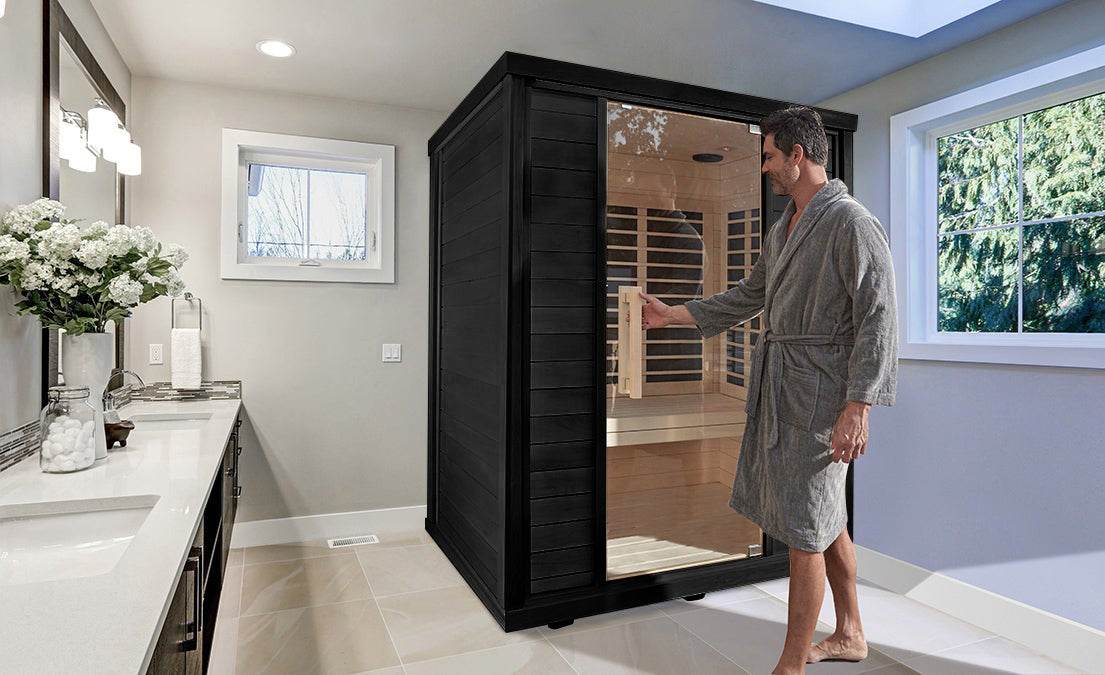
What to Avoid: Red Flags When Buying
Infrared saunas attract a lot of low-quality entrants because the barrier to manufacturing is low and the margin on a $299 portable sauna tent is high. Here's what to watch for:
- No EMF data published. If a brand can't produce a specific milligauss reading from a named lab, assume the worst. "Low EMF certified" without documentation is a marketing phrase, not a measurement.
- No-name brands with no customer service infrastructure. Search the brand name + "warranty claim" or "customer service" before buying. A sauna with a broken heater and no support channel is an expensive paperweight.
- "1000W" or wattage marketing without heater specifics. Wattage tells you power draw, not heat quality or coverage. A 1,000W unit with two ceramic panels in the back delivers a very different experience than a 1,000W unit with 9 carbon panels covering four walls. Ask about heater count, placement, and type — not just wattage.
- "Full body" claims from back-only heater configurations. If the product images show heaters only on the back wall and the listing claims "full body infrared therapy," that's marketing overreach. True full-body coverage requires panels on multiple walls.
- Very short warranties. Any warranty under 1 year on the heaters (or under 2 years on anything) on a unit priced above $600 should be an immediate pass. Heater failures often appear in the second or third year — a 1-year warranty won't protect you.
- Unspecified wood type. "Wood" or "pine" on a sauna listing is a yellow flag. Pine has high resin content, can emit fumes at sauna temperatures, and warps faster than hemlock or cedar. If they won't specify the wood species, they're probably hiding a budget substitution.
Setup Requirements Most Buyers Don't Realize
Infrared saunas are significantly easier to set up than traditional saunas — but there are still a few things that catch buyers off guard:
Electrical
- 1-person infrared saunas: Almost all plug into a standard 120V/15A household outlet. No electrician needed. This is a major advantage over traditional saunas.
- 2-person and larger saunas: Typically require a 240V/20A circuit — similar to a dryer outlet. If you don't already have one in the installation location, budget $200–$500 for an electrician to run a dedicated circuit. Exception: The Sun Home Equinox 2 runs on a standard 120V/20A circuit (NEMA 5-20p plug) — verify the specific model's requirements before assuming all 2-person saunas need 240V.
- Never use an extension cord with a sauna. If the outlet isn't in the right spot, hire an electrician.
Assembly
- Most 1-person and 2-person home infrared saunas use tongue-and-groove wood panel assembly — no tools required beyond hand tightening connectors.
- Typical assembly time: 1–2 hours for one person. Having a second person helps align the roof panels.
- Weight: 1-person models typically weigh 200–300 lbs assembled. Plan your installation location before delivery — moving an assembled sauna is difficult.
Indoor Only
Home infrared saunas are not weather-sealed and are strictly for indoor use. They lack the waterproofing and weatherproofing of barrel saunas and outdoor traditional sauna kits. A garage, spare bedroom, or basement is ideal — somewhere with stable temperature and low humidity. Do not place them in an uninsulated, unheated space (like an unfinished garage in a cold climate) — the electronics and wood are not rated for outdoor temperature swings.
Space
1-person saunas typically require a footprint of roughly 3' × 3' to 3.5' × 4'. Add clearance on all sides for ventilation. 2-person models run 4' × 4' to 5' × 4'. Measure your intended space including ceiling height (most require 7+ feet) before ordering.
Infrared vs. Traditional Sauna: Quick Summary
The short version: infrared saunas heat your body directly at lower air temperatures (120–150°F); traditional Finnish saunas heat the air to very high temperatures (180–210°F) and heat your body through convection. Most of the landmark sauna health research — particularly the long-term Finnish cardiovascular studies — was conducted with traditional saunas. Infrared-specific research is accumulating but the body of evidence is smaller. For home use, infrared wins on practicality: faster heat-up, lower electricity cost, easier installation, and no steam or plumbing required.
For the complete comparison — including how the two types differ in sweat output, health benefits, cost, and recommended protocols — read our full Infrared Sauna vs. Traditional Sauna breakdown.
What the Research Says
A brief note on evidence: most sauna health research uses traditional Finnish-style saunas, not infrared. The landmark cardiovascular studies (Laukkanen et al., 2015, 2018) followed 2,300+ Finnish men over decades and found regular sauna use associated with significantly reduced cardiovascular disease mortality. These findings are powerful — but they are for traditional sauna use.
Infrared-specific research is smaller in scale. A 2018 review in Evidence-Based Complementary and Alternative Medicine found far infrared sauna use associated with improved vascular function and blood pressure reduction. A 2019 study in Complementary Therapies in Medicine found infrared sauna use beneficial for chronic fatigue symptoms. The mechanisms — core temperature elevation, sweat-induced detoxification, cardiovascular strain response — are similar to traditional sauna, and the benefits are plausibly equivalent, but the direct comparative evidence is limited.
Bottom line on research: Infrared saunas produce genuine physiological responses (elevated heart rate, sweating, temperature increase) that overlap substantially with traditional sauna. These are demonstrated physiological responses, not manufacturer marketing claims. The cardiovascular evidence — particularly the long-term Finnish studies — is strongest for traditional sauna use. Infrared-specific research is accumulating but is smaller in scale. The magnitude of benefit relative to traditional sauna is not definitively established.
Evidence grading note: Throughout this guide, we distinguish between (a) demonstrated physiological responses, (b) observational associations from cohort studies, (c) preliminary clinical evidence from small trials, and (d) mechanistic theory based on known biological pathways. When a claim is supported primarily by mechanisms rather than outcome data, we note it. Statements about specific health benefits should not be interpreted as medical advice. Consult a physician before beginning sauna use, particularly if you have cardiovascular conditions or are pregnant.
Frequently Asked Questions
Sources & Further Reading
- Laukkanen JA, et al. (2015). Association between sauna bathing and fatal cardiovascular and all-cause mortality events. JAMA Internal Medicine.
- Laukkanen T, et al. (2018). Sauna bathing is inversely associated with dementia and Alzheimer's disease. Age and Ageing.
- Hussain J & Cohen M. (2018). Clinical effects of regular dry sauna bathing: a systematic review. Evidence-Based Complementary and Alternative Medicine.
- PubMed — sauna and infrared therapy research
Get weekly guides from PlungeHQ
No spam. Unsubscribe anytime.